Solving Bitcoin's Biggest Problem through Human-to-Human Communication
We speak the language of network effects, cryptographic hashes, and peer-to-peer electronic cash.
This makes sense, right? Bitcoin is computational. Its logic is math.
But even in the age of AI agents, the ultimate users of the Bitcoin network are people.
WE are the ones who install ASICs, spin up nodes, sign transactions, and build software.
And more than that, WE are the ones who make decisions.
Our decisions, just like everyone’s, are based on experience, trust, and emotion (as well as information).
Most bitcoiners and companies in the space still use these computerized terms to sell the dream of a better world.
In this article, I’m going to tell you why this is Bitcoin’s biggest problem, and how you, and all the humans of Bitcoin, can be the heroes that save the day.
(alternatively, watch the video below).
The Attention Economy Is Working Against Bitcoin
The mainstream media's relationship with Bitcoin is predictable: bear versus bull, price rising versus price crashing. Within the Bitcoin community itself, the narratives are still polemic: KYC versus non-KYC, Core versus Knots. These framings are engineered for attention. Content on these topics generates a brief spike of outrage or excitement, then the audience clicks away, and the cycle resets. They don’t encourage deep thought or nuanced discussion.
Bitcoin has no founder in the traditional sense, no Steve Jobs or Sam Altman for journalists to profile. So traditional media fills the gap with criticism: Trump’s shitcoinery, lost wallets in a landfill, scams, and seizures. Any story with a human face attached to failure travels far.
Within the industry, the counter-narrative is more positive but totally faceless. Institutional adoption, policy developments, and new technologies — these are stories that attract systems thinkers, engineers, and developers. People with a GitHub account or a toolbox in the garage. That is the demographic that already knows about Bitcoin. The 95% who are not yet in the space do not think this way, and headlines aimed at systems thinkers simply do not reach them.
Pitching Bitcoin Is Not the Same as Telling a Story
Most bitcoiners have given a futile five-minute pitch, an attempt to compress years of learning into a diatribe about why someone should abandon the money they know and trust in favour of "magic internet money." It rarely works, and the reason is structural.
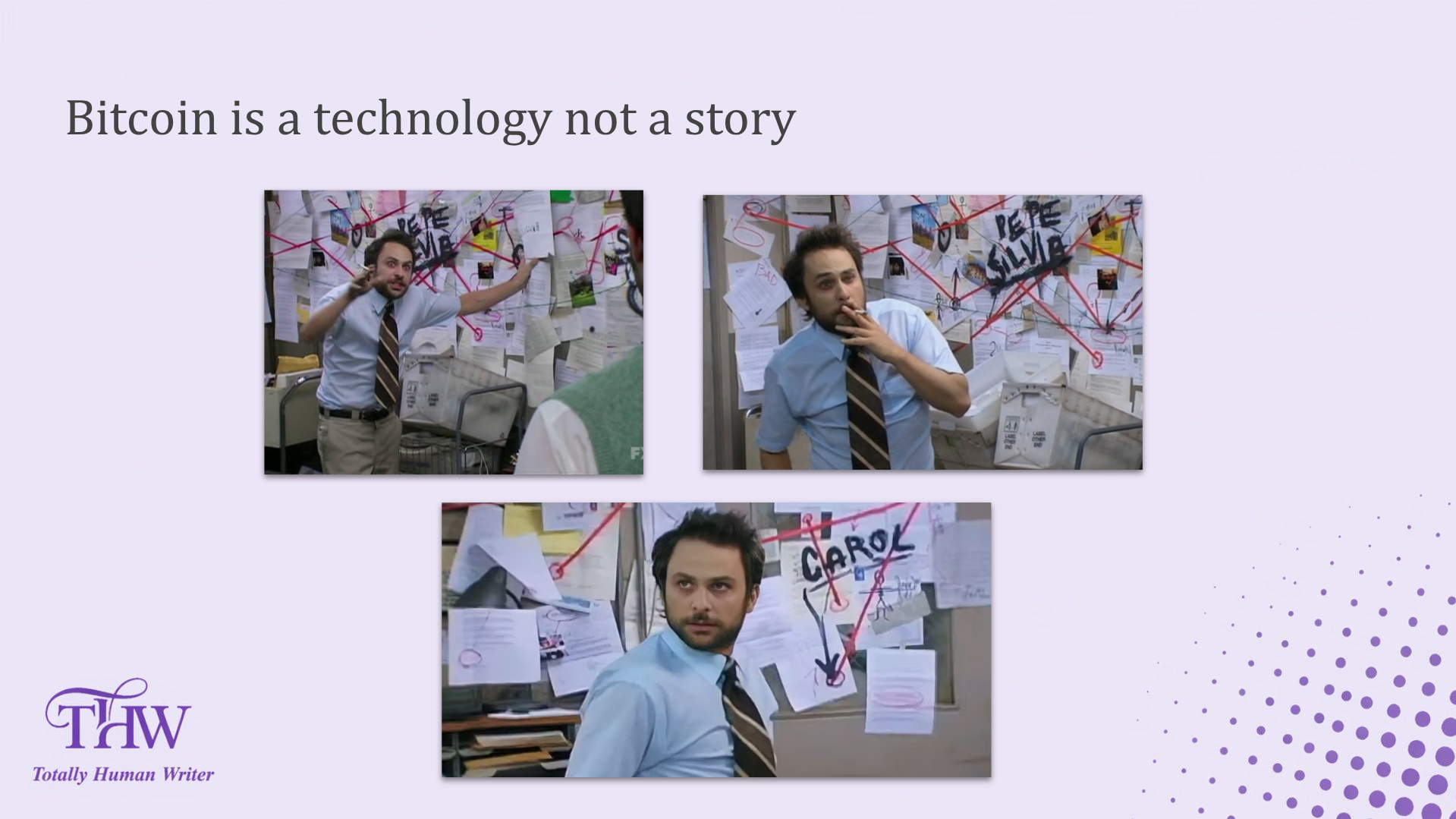
Bitcoin is not a story. It is a technology, extraordinarily complex, wide-ranging, and far-reaching. But fire was not a story. The printing press was not a story. The motor car was not a story. The internet was not a story. Technologies become stories only when people share what those technologies do to human lives.
Useful technologies solve technical problems. But problem-solution is NOT a story.
A story requires three elements: conflict, characters, and resolution.
Conflict is a problem difficult enough to generate genuine suspense and intrigue. Bitcoin has conflict in abundance (the problems of the fiat world are real and significant), but that conflict is abstract and too complex for most people to grasp without context.
Characters must be three-dimensional, not archetypes like the nocoiner normie or the sovereign maximalist. Real people have flaws, vulnerabilities, and inconsistencies. These make 3D characters that audiences can genuinely empathise with. For example, I enjoy watching people punch each other in the face inside a cage, but I also make up nicknames, songs, and dances for the two cats I keep as pets. I make inspired decisions on some days, and on others, I leave my glasses in the microwave or spend 27 minutes picking a scab. That is humanity. It’s honest and real. Characters must change, too. Maybe one day, I’ll learn not to pick scabs.
Resolution is where Bitcoin storytelling fails most consistently. The community is so focused on problem and solution that it neglects to show the effects — what Bitcoin actually does for real people's lives. Without resolution, there is no satisfying arc, and without a satisfying arc, there is no story worth sharing.
Who Are We Actually Talking To?
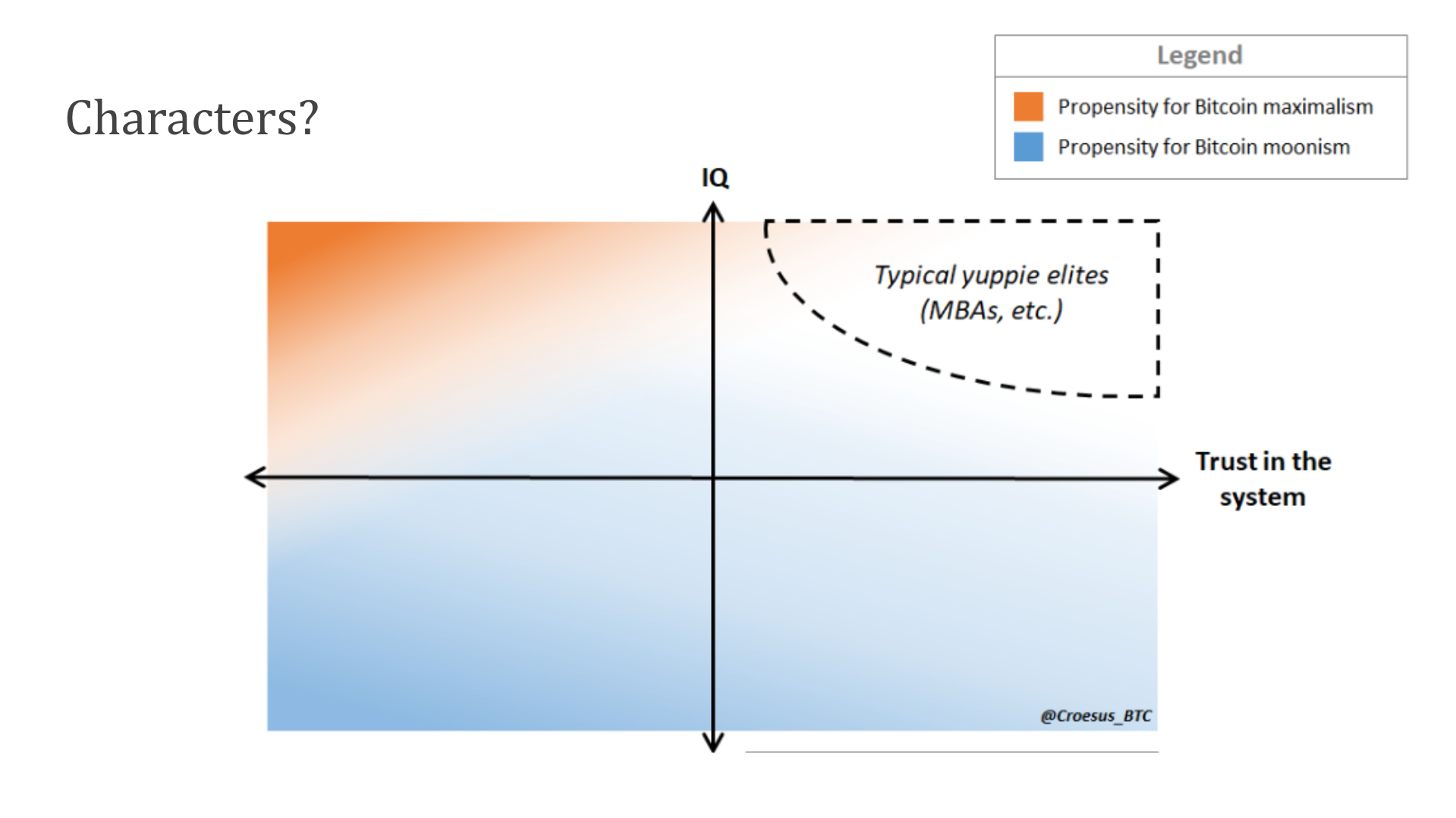
Let’s think of the adoption curve as a marketing plan. Effective marketing plans are not scattergun approaches. They are targeted. The early adopters watching a Bitcoin conference talk are not the audience that needs convincing. The next wave is.
Every group along this curve has different mindsets, different emotional triggers, and their brains are wired differently.
I often ask my clients, ‘Who is your ideal client profile?’
‘Everyone except trad-fi yuppie elites,’ they say.
Sigh. There is no one approach or message that resonates with everyone.
When I push them further, they usually describe someone with eight-plus years in the space and a GitHub account. Those people are already here! The real work is identifying where potential users actually are — emotionally, financially, psychologically — at any given moment. People are not fixed points on an adoption curve. They shift. They are inconsistent, just like you and me.
From Burnout to Timelord: My Bitcoin Journey

I call myself ‘totally human’, not because I hate AI, but because I want to embed humanity into my work. ‘Totally human’ shouldn’t be necessary to add for writers, but in 2026, it is. That’s kind of the joke. If you can recognise this as playful and not literal, then I’ve shown you a bit of who I am. You’ve begun writing my story in your mind.
I went to my first conference in Madeira in 2024 to promote the world’s first Bitcoin fiction anthology. At that time, I was trying to figure out how to balance the stress of running a coaching business with writing fiction, my long-term passion. The conference was a nice break and a chance to learn.
The problem was I felt too nervous to speak to anyone. I’m used to looking at words on a screen, not networking and passing my business card to Jack Mallers, Lyn Alden, or Jeff Booth. They were all just walking around chatting with people! I felt terrified of being found out in a technical discussion (I am not a developer, and I haven’t been in Bitcoin since 2011, like most of them). So I just listened to some of the issues people were talking about.
That same year, I was feeling totally burned out running my coaching business. It’s so tiring to fail, try again, and fail again. I was working 6 or 7 days a week to make the same money I earned in an advertising job I had in 2009. Putting weeks of effort into a new course or service and hearing crickets as a response is crushing.
I decided to transition to my passion — writing. After making lists upon lists of the best niches and possible clients, it hit me. I was constantly thinking about that conference in Madeira, and there was a gap in the market where virtually no one had niche knowledge and strong communication skills.
Getting inspired by listening to and meeting others with real stories at that conference was the tipping point for me to change the direction of my life.
The biggest difference for me now is I can say ‘no’ more. I say ‘no’ to bad bosses and mechanical tasks. I say ‘no’ to shitcoin clients. I say ‘no’ to anything that I don’t want to focus my energy on.
Working with the humans of Bitcoin gave me control and sovereignty over my time. That’s the happily ever after for me.
Who cares? You think. That’s YOUR story.
What’s in it for MEEEEEEEEEE?
Well, I believe that character, conflict, and resolution is a better way to share what I do than any ROI percentage charts or newsletter readership numbers.
And In order for any of us to succeed in Bitcoin, we must help plebs, investors, partners, and even FT readers see the EXPERIENCE that formed our ideas, and communicate the EFFECTS it had on us.
I ensure the input of my writing is based on real lived experience, and I make sure the output is relatable and relevant for real humans. Maybe you want to reclaim sovereignty over your time again? Perhaps you will have your Madeira moment soon.
We care about ourselves, and we relate to others.
That’s actually a good mindset to adopt when thinking about your role in Bitcoin.
No one cares about you, your product, or even Bitcoin. They care about how it affects them. They want to connect with your stories only so they can apply the meaning to their own lives.
Persuasion Has Seven Levers — Bitcoin Is Only Pulling One
Communication in Bitcoin must show the real human experience that shapes our work, and the real human effects of it. Focusing on the product, service, or network itself misses the mark because it fails to persuade people whose attention is elsewhere.
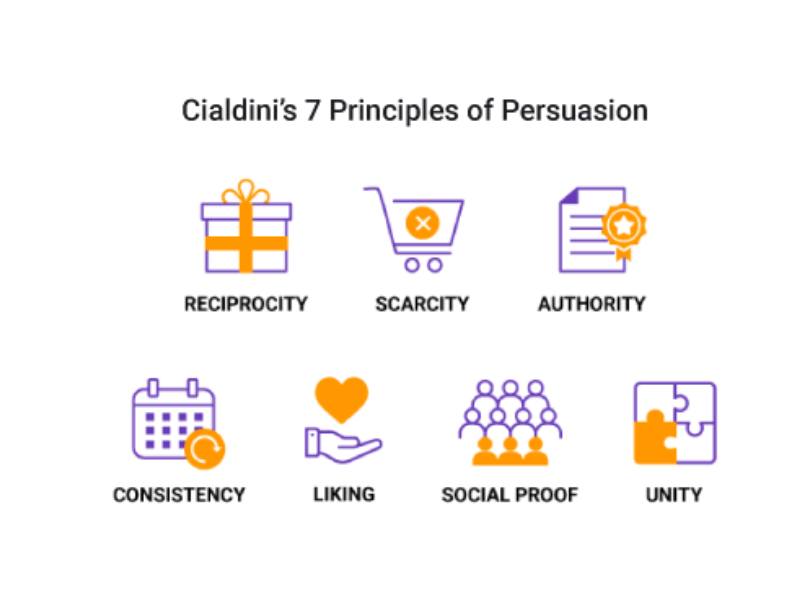
We must get better at persuading. Of Cialdini's 7 principles of persuasion, Bitcoin is only doing scarcity well. The other emotional levers are being left largely untouched.
Reciprocity means offering before asking. We should share expertise first, offering interviews, giving up time, and only then making a request. Authority means backing claims with evidence (e.g., the way analyst Daniel Batten rigorously supports his work in the energy sector). We need more of this. Consistency does not mean posting a dozen times a day; it means sticking to a message so that people understand who you are and what you stand for. Likeability requires vulnerability. Platforms like LinkedIn can generate incredible connections and partnerships if you are willing to share challenges, failures, and real-life imperfections rather than only company announcements and product updates. For example, I once spent three days looking for my glasses before I found them in the microwave. Social proof means making users and customers the stars of the story, not the technology. Finally, unity is something we can show in Bitcoin by championing good actors and opinions that align with Satoshi’s principles.
If we tap into these principles of persuasion, readers, listeners, and viewers say ‘YES. That’s me!’ or ‘I AM interested.’ That the goal of communication for me.
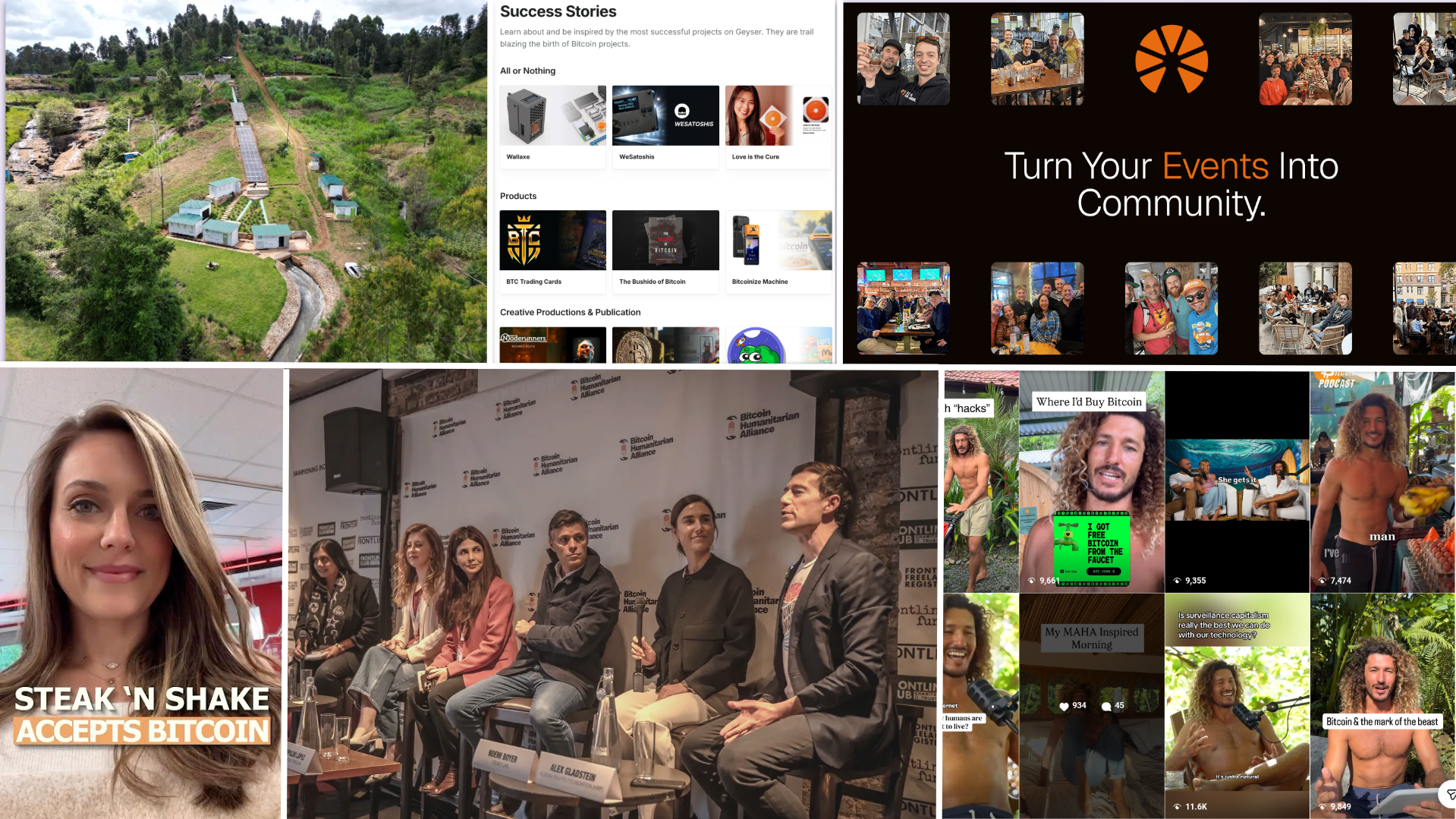
A quick mention of the companies in the space doing this well at the moment:
Gridless — a mining operation that electrifies rural communities in Africa and shares the impact on local people.
Geyser — a crowdfunding platform that shares how campaign were successfully funded.
Club Orange — a meetup app for bitcoiners which shares photos and stories from communities across the world.
Steak ‘n’ Shake — A fast food chain that created a buzz with user-generated content for its Lightning integration.
Human Rights Foundation — an NGO that encourages its own project leaders to share stories on stage about the human impact of Bitcoin.
Primal — A Nostr client whose team lives in the jungle in Costa Rica, sharing stories of circular economies, sloths, and surfing.
I'm sure there are more good examples of Bitcoin-native comms. If you know of one, please get in touch to mention it.
LLMs are Backward-Facing; Creativity Writes the Future
Strauss Zelnick, the CEO of Rockstar Games, recently dismissed the idea of AI generating a hit game like Grand Theft Auto as a laughable idea. That’s because creativity is informed by data and seeks to create something unique, surprising, and new, while AI is big data sets, lots of compute power, and a large language model. LLMs can only rehash existing data into derivative assets. This will not create a hit video game. Neither will it move the needle in Bitcoin adoption.
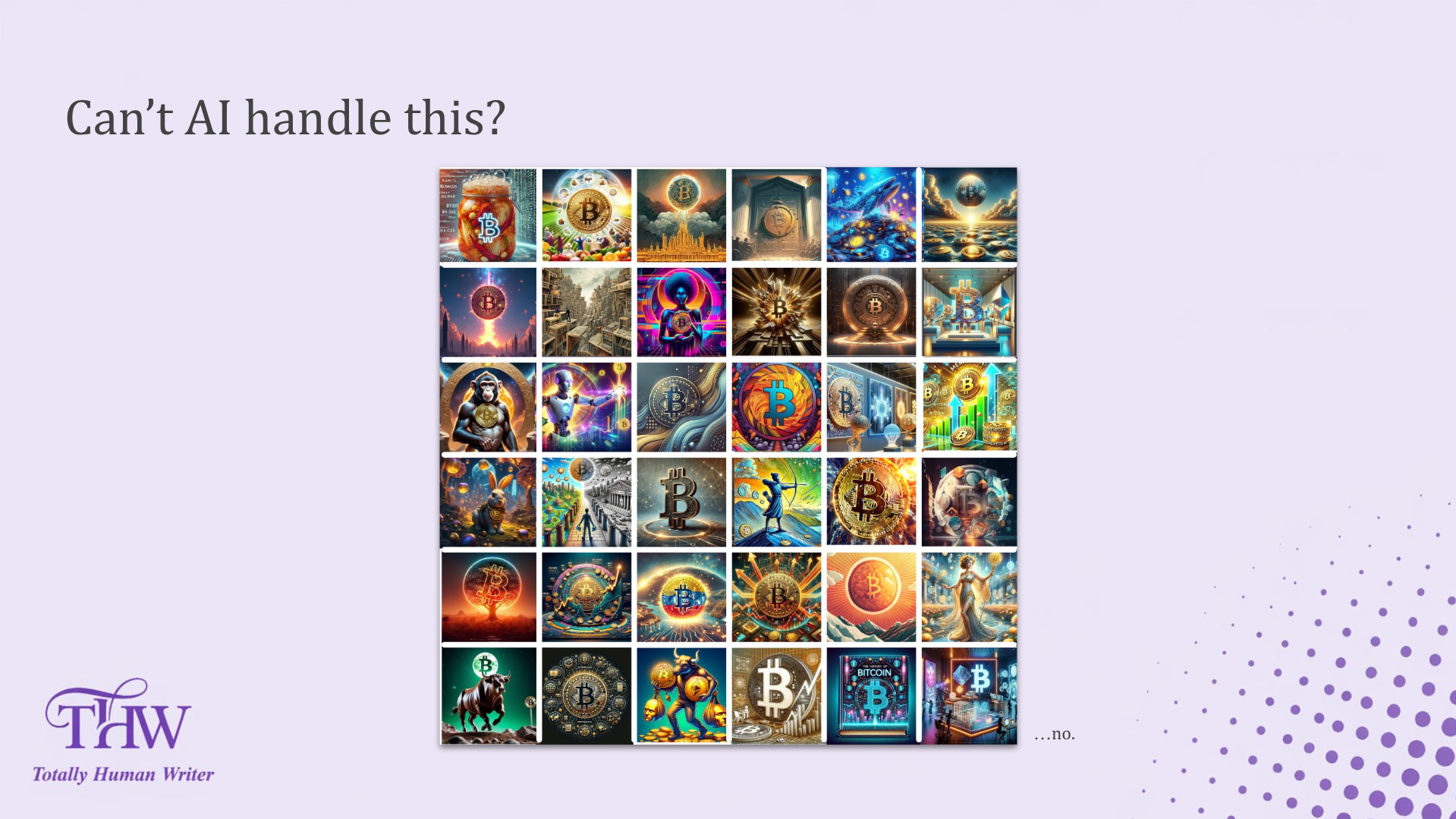
Look at this grid of AI-generated thumbnails and graphics. Imagine that behind each one lies a video, an article, a podcast. Which ones look worth investigating? None of them. If there is no proof of work in the image, the assumption is that there is no proof of work in the content.
More fundamentally, the value in content is the biological lived experience that informed it and went into producing it. As the marginal cost of generating machine content trends toward zero, the premium on authentic human expression goes up and to the right.
Real, unfakeable time and effort are scarce, and IRL experiences are back in style. In Bitcoin, we must not outsource the work to machines or anyone else. For our communication to be valuable, we must invest in it.
My Three Mantras for Better Bitcoin Communication
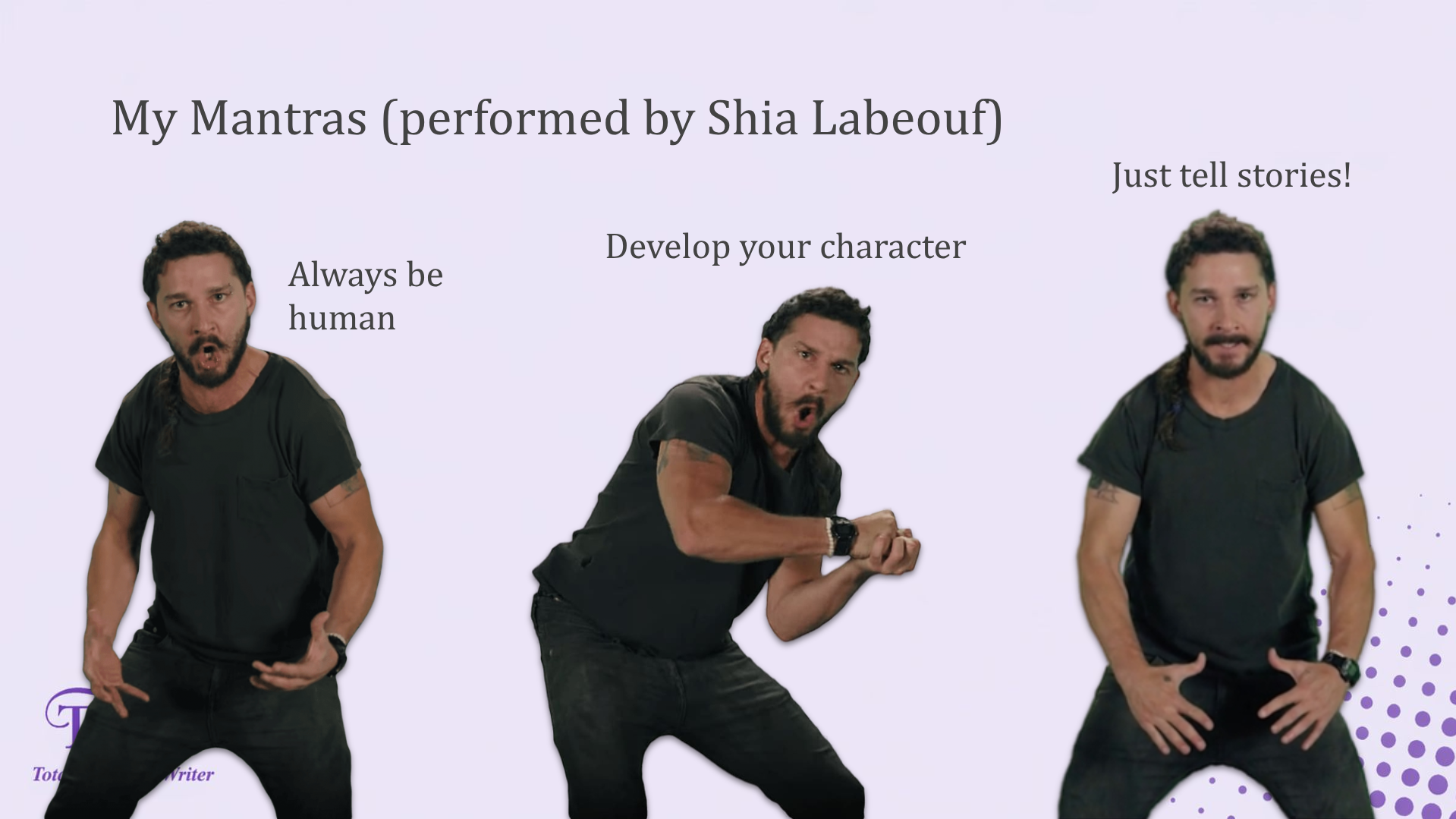
For anyone working in Bitcoin, whether building a product, running a community, or simply trying to bring a friend or family member into the fold, I humbly present three actionable mantras.
Always be human:
Start by remembering that every decision is made by a person. You are a human speaking to a human. These are our decisions, our impact, our lives. WE are the ones who write the future of Bitcoin and its impact on our species.
Develop your characters:
If you are sharing your own story, go deeper than the surface version. Share your vulnerabilities, your contradictions, the messy human reality of your journey. If you are trying to reach a user or customer, resist the temptation to flatten them into a demographic. Build a full, three-dimensional picture of where they are right now.
Just tell stories:
Don’t get stuck in problem-solution mode. Embrace conflict, invest in characters, and show the impact of your work. Share what Bitcoin actually does for people. That is where the story lives.
The humans of Bitcoin have everything they need to communicate better and get the results they want. To get there, we should listen to each other, draft our characters, and do the hard work of crafting stories.
Bitcoin is built on proof of work. Its communication should be too.